

Seismic events such as the coronavirus (COVID-19), and the financial crash of 2008/09, typically arrive suddenly and have a dramatic downward impact on valuations. Currently, the M&A market in 2021 is at an all-time high with increasing deal values. When these events happen, it is perhaps understandable that expectation and valuation gaps in a transaction are increasing. As a result of the pandemic, buyers now find themselves under even more pressure to reflect the impact of pre and post-com-pletion disruption of the business in the final purchase price. Therefore, we expect an increase in the number of M&A claims caused by COVID-19 and we already observe this development in our business practice. Sellers can be confronted with significant claims for damages - especially in times where target values are high. W&I insurance policies cover this risk and protect the parties involved from the impact of warranty breaches and indemnification claims. What decision makers should know.
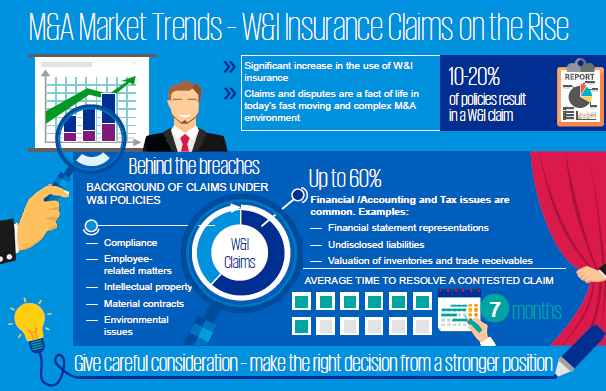
The global challenge of COVID-19 and high market prices are putting companies under increasing pressure to actively assess purchase price clauses, representations and warranties to maximize deal value. Overall, on both current and future deals, we anticipate that the M&A agreement is going to become increasingly important for both buyers and sellers in trying to protect deal value. W&I claims will continue to rise, given how popular the W&I product is in the current M&A market. Studies and our own observations indicate that between 10 and 20 percent of M&A transactions with a W&I insurance policy result in a W&I claim. The boom in popularity of W&I insurance on deals will inevitably lead to an increasing frequency of W&I claims merely through the increased number of W&I policies.
The speed and breadth of the unfolding COVID-19 crisis is putting nearly every facet of business to the test. In many cases, the impact of COVID-19 is likely to lead to disillusionment after the signing of an M&A transaction. The specific expectations regarding the performance of the target will likely be missed. This means that buyers are increasingly looking for ways to subsequently reduce the purchase price even if the M&A market continues to recover.
In general, economic downturns and volatile markets lead to more disputes. This is a key observation of eco-nomic downturns in the past and also applies to the COVID-19 downturn. Parties in a transaction are under pressure to maximize deal value. Furthermore, in 2021 the M&A market booms and the prices are increasing. Now, the buyers are trying to optimize the deal values to avoid the risk of an overpayment.
Overall, an increasing number of post M&A claims is expected. This will be a direct consequence of the eco-nomic downturn caused by the pandemic. Before the pandemic, post-M&A disputes could be observed in 10 to 15 percent of all transactions with already an increasing trend. We expect this trend to intensify as a result of the pandemic. We already observe this in the rising demand for M&A dispute services.
High prices, disappointed investors
The use of W&I insurance policies increased significantly from 10 percent in 2010 to 19 percent of all M&A trans-actions in 2019. Even though the use decreased in 2020 by 2 percentage points to 17% due to COVID-19, insur-ance brokers reported a strong increase at the end of 2020. Based on our experience, this trend continues. Dealmakers appreciate the benefits of W&I insurance policies. According to market studies and our own observa-tions, between 10 and 20 percent of M&A transactions result in an M&A or W&I claim.
High prices paid in M&A transactions due to positive market conditions in recent years mean an increased risk that targets are perceived to perform below expectation post-transaction. Buyers are desperate to find ways of recouping damages. It is obvious that they look at warranty breaches as a basis for claims.
Issues relating to financials are the key drivers of M&A disputes and W&I claim notifications. This comes as no surprise as financial data is of utmost importance in valuing a target company and is therefore reflected in contractual representations, warranty and indemnity provisions. More than 50 percent of all M&A agree-ments include purchase price adjustments, such as working capital and net debt adjustments or earn outs, determining the final purchase price of a company post-closing. A conflict often arises due to differing in-terpretations of the contractual basis of preparation and the relevant accounting principles to be applied. Specific language setting out the methodology to be applied when calculating purchase price adjustments post-clos-ing is helpful to avoid M&A disputes. However, one should be aware that accounting principles are not only complex but also contain judgmental elements subject to interpretation.
No two purchase price disputes are the same. However, many share common underlying issues and themes. Disputes regularly arise when the buyer receives the post-closing adjustment calculation and asserts that the seller has overstated assets or undisclosed liabilities.
Common examples of this are the understatement of accruals and provisions, the impairment of inventories and trade receivables and cut-off issues in general. The application of generally accepted accounting principles (GAAP) versus consistency with past practice is another recurring issue in purchase price disputes. The parties disagree about whether GAAP or consistency should be the overriding principle for the post-closing adjustment. Breaches of warranties and indemnifications are further key drivers of post-M&A disputes and W&I claim notifi-cations. Breaches concern mainly financial statements, tax issues, compliance with laws, employee-related aspects and intellectual property.
Claims often involve large sums of money reaching millions of Euros
M&A disputes and claims are a fact of life in today’s fast-paced and complex business environment. Companies are faced with an increasing number of complex M&A disputes. Large sums, usually in the millions, are regularly at stake in post-M&A disputes and W&I claim discussions. In view of rising M&A volumes in recent years and the high number of disputes, W&I insurance has increas-ingly been chosen as an effective and elegant solution to cover risks.
W&I insurance policies is especially used for bigger deal sizes. Half of deals in excess of $100m include such a W&I insurance policy. The growing popularity is also a result of declining insurance premiums. In Europe, they are now around 1 percent of the risk to be insured, or even lower. At the same time, insurable amounts have risen, with cover exceeding € 500m now available. Therefore, policy premiums and retention levels remain very competitive. Another driver of the growing interest in W&I policies is the fact that insurance companies have hired employees with excellent M&A expertise, who are able to provide tailor-made products even within the typically tight time frame of an M&A transaction.
Another driver of the growing interest in W&I policies is the fact that insurance companies have hired employees with excellent M&A expertise, who are able to provide tailor-made products even within the typically tight time frame of an M&A transaction.
So-called ‘buy-side policies’ provide protection against damages from warranty breaches or indemnity claims directly to the buyer. This type of policy has achieved a market share of more than 90 percent.
W&I policies are useful for both sides
Obviously, a buy-side W&I policy protects buyers against breaches of warranty or indemnity claims and ensures a solvent debtor in the event of damages. But sellers also benefit from the fact that the risk of a breach of con-tract is covered and transferred to the insurer. In this way, sellers can fully protect themselves and use the final proceeds from the transaction much earlier for new investment or return funds to investors much sooner. The need for an escrow may become obsolete.
W&I policies ensure a prompt, clean and final deal exit, which is a vast advantage in many cases - such as the exit of a private equity company or a sale out of insolvency.
But be careful: enforcing and handling W&I claims can be a challenging task. Because of the complexities, differing interpretations of accounting principles, and the lack of specificity around the financial provisions in many sale and purchase agreements, buyers and sellers often find themselves in dispute over these provisions.
W&I claims merit careful consideration
When M&A claims arise, it is important to gather the relevant facts, isolate and understand the key commercial and financial issues and identify the economic implications as soon as possible. M&A claims can involve complex economic, financial and technical issues, as well as multiple languages, client locations, applicable laws and accounting standards. The documentation and enforcement of claims is very challenging.
During the entire process it is essential that the lines of argumentation presented in reports and statements issued to the other party, the insurer, the independent expert or the arbitration court are clearly comprehensible for a third party. A party should only submit comprehen-sively and professionally prepared documentation and reports, which convincingly supports and substantiates its own position entirely. Support from dedicated experts who regularly deal with such M&A claims is essential. Experts have extensive experience of presenting evidence based on thorough research and responding to challenging enquiries.
The analysis of the legal and economic basis for claims and the subsequent damage assessment are anything but trivial. M&A SPAs are individually negotiated, with many different factors and aspects coming into play in the challenging situation of a claim notification that need to be considered against the background of the terms of a W&I policy. Support from dedicated experts who regularly deal with M&A claims is essential in success-fully handling W&I claims. It is critical that these experts can provide extensive experience of presenting well-researched evidence and responding to challenging enquiries.
A realistic view of the reasonable settlement range allows both sides to negotiate from an informed position and to settle the claim efficiently. At the same time, this forms the basis for developing trust and a long-term business relationship.
